
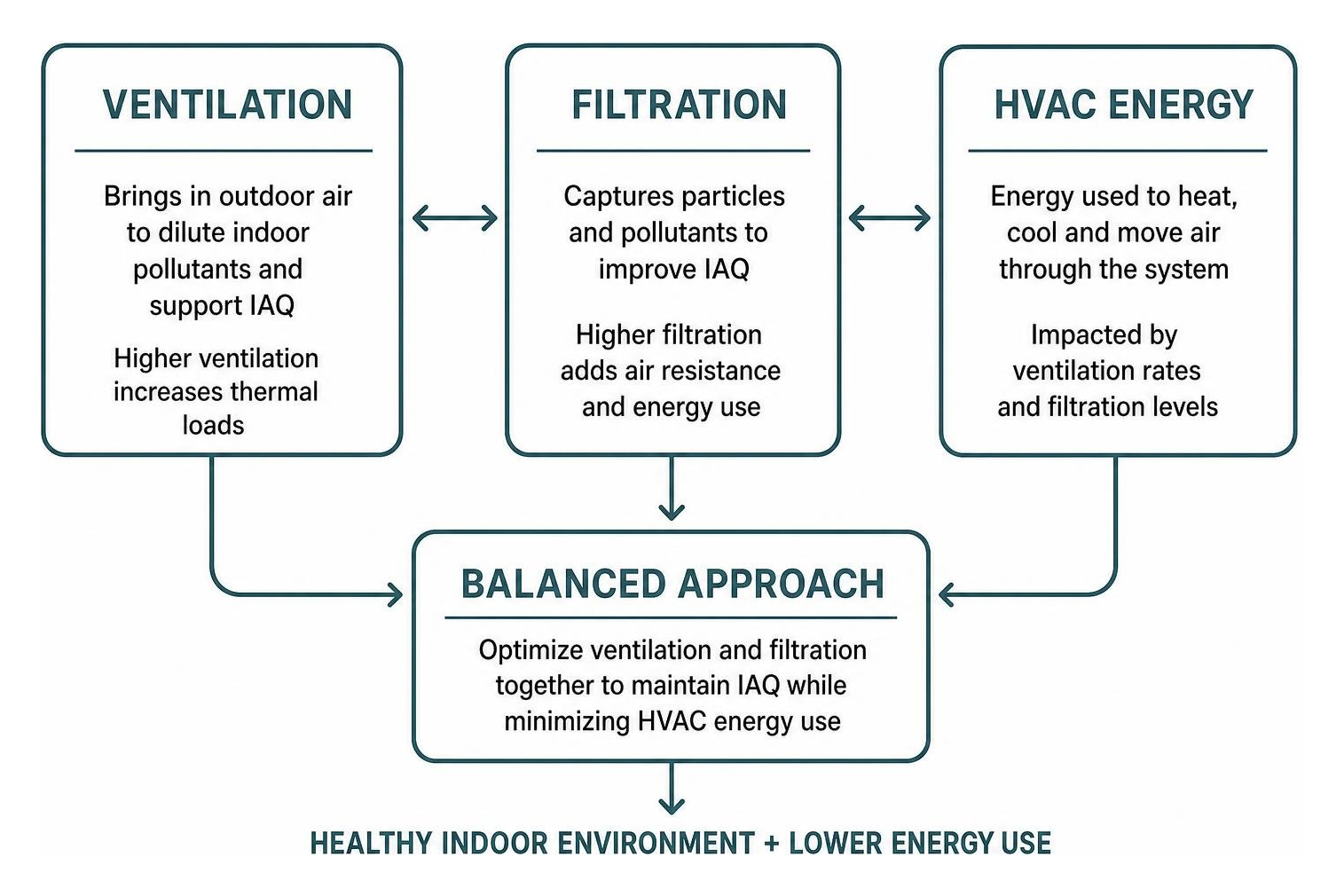
The pursuit of optimal indoor environments often presents a complex trade-off between maintaining superior indoor air quality (IAQ) and achieving high HVAC energy efficiency. Modern buildings are increasingly focused on building decarbonization goals, which necessitate a significant reduction in energy consumption. However, this must not come at the expense of occupant health and comfort. HVAC systems are central to this challenge, as they directly influence both the air we breathe and a building's overall energy footprint. Understanding the intricate relationship between ventilation, filtration, and thermal management is key to striking this balance.
Effective HVAC design moves beyond simply meeting baseline energy use and instead focuses on optimizing performance across various operational conditions, particularly part-load performance. This is crucial because HVAC systems rarely operate at their maximum capacity. Factors such as external weather conditions, internal heat gains, and occupancy levels constantly shift thermal loads, requiring systems to adapt dynamically. The goal is to provide precise control over temperature, humidity, and air purity without excessive energy expenditure. For those seeking expert guidance on integrating efficient systems, professional heating and cooling services can provide tailored solutions.
Here’s a comparison of how different HVAC configurations impact energy performance, ventilation effectiveness, and IAQ:
HVAC Configuration Energy Performance Ventilation Effectiveness IAQ Metrics (Typical) Constant Volume (CV) System Lower (less efficient at part-load) Moderate (fixed airflow) Variable (depends on filtration) Variable Air Volume (VAV) System Moderate to High (better part-load) Good (airflow adjusts) Good (can integrate advanced filtration) Dedicated Outdoor Air System (DOAS) with ERV High (optimized fresh air) Excellent (controlled OA) Excellent (multi-stage filtration, humidity control) Variable Refrigerant Flow (VRF) System Very High (zone-specific control) Moderate (often paired with separate ventilation) Good (can be enhanced with external IAQ solutions) Ground-Source Heat Pump (GSHP) Very High (stable ground temps) Moderate (often paired with separate ventilation) Good (can be enhanced with external IAQ solutions)
Dynamics of Indoor Air Quality and HVAC Efficiency Under ASHRAE Standards
Industry standards, particularly those from ASHRAE, are continually evolving to address the dual goals of IAQ and energy efficiency. The ASHRAE 62.1-2025 IAQP (Indoor Air Quality Procedure) represents a significant shift from traditional prescriptive ventilation rates. Instead of simply dictating minimum outdoor air volumes, the IAQP encourages a performance-based approach that focuses on maintaining acceptable levels of specific indoor air contaminants. This method allows for more flexible and potentially more energy-efficient ventilation strategies.
Under the IAQP, systems are designed to respond to real-time measurements of multi-pollutant metrics. This includes monitoring and controlling levels of particulate matter, with strict PM2.5 thresholds (e.g., 15 µg/m³), CO2 limits (e.g., 900 ppm above outdoor levels), and targets for TVOC reduction (e.g., 500 µg/m³). By actively sensing and managing these pollutants, ventilation can be dynamically adjusted, ensuring clean air only when and where it's needed. This approach allows for operation within defined operational bounds, preventing both under-ventilation (poor IAQ) and over-ventilation (wasted energy). For instance, a system might reduce outdoor air intake during periods of low occupancy and good air quality, saving fan and conditioning energy, while ramping up ventilation during peak occupancy or pollutant-generating activities like cooking.
The Role of Total System Performance Ratio and Part-Load Operation
To accurately assess and improve HVAC efficiency, a holistic metric is required that goes beyond individual component ratings. The Total System Performance Ratio (TSPR) is emerging as a critical metric for evaluating the overall energy performance of HVAC systems. Unlike traditional metrics that rate equipment at full load, TSPR considers the annual heating and cooling load of a building relative to the total annual energy consumed by the HVAC system. This comprehensive approach accounts for part-load performance, controls, and the interactions between all system components.
Implementing TSPR in building codes encourages the adoption of more efficient system designs. By setting minimum TSPR targets, jurisdictions can drive significant energy savings. The mechanical performance factor within TSPR calculations allows for normalization, ensuring that energy credits are given for efficient HVAC operation rather than just building envelope improvements. Technologies that excel in part-load conditions, such as variable refrigerant flow (VRF) systems and ground-source heat pumps (GSHP), are particularly well-suited to meet stringent TSPR requirements. VRF systems offer precise zone-by-zone control, while GSHPs leverage stable ground temperatures for highly efficient heating and cooling. Furthermore, integrating economizer cycles, which use outdoor air for cooling when conditions are favorable, significantly contributes to TSPR improvements. Addressing issues like duct air leakage is also vital, as even minor leaks can substantially reduce system efficiency and compromise IAQ by drawing in unfiltered air.
Advanced Mechanical Strategies for IAQ and Energy Performance
Achieving superior indoor air quality and energy performance often requires moving beyond conventional HVAC designs to incorporate advanced mechanical strategies. These innovations focus on optimizing fresh air delivery, managing moisture, and recovering energy that would otherwise be lost. Such strategies are particularly vital in the context of green building certifications like LEED certification and Estidama standards, which demand high performance across environmental metrics.
Traditional systems, often relying on split AC units, can struggle to manage both sensible and latent loads effectively, especially in challenging climates. The thermal envelope of a building plays a crucial role, but even with a well-designed envelope, the HVAC system must efficiently handle the remaining thermal and moisture loads. Advanced systems aim to pre-condition outdoor air, recover energy, and manage humidity more precisely, leading to significant energy savings and improved comfort.
Dedicated Outdoor Air Systems and Enthalpy Recovery Wheels
One of the most effective strategies for simultaneously improving IAQ and energy efficiency is the integration of Dedicated Outdoor Air Systems (DOAS) with energy recovery ventilation (ERV), particularly using enthalpy wheels. A DOAS is designed solely to condition and deliver outdoor air for ventilation, separating this function from the space conditioning provided by other systems. This allows for precise control over the amount and quality of fresh air introduced into a building.
When combined with enthalpy wheels, DOAS units become even more powerful. Enthalpy wheels are rotating heat exchangers that transfer both sensible heat (temperature) and latent loads (humidity) between the incoming fresh air and the outgoing exhaust air. In cooling seasons, the cool, dry exhaust air pre-cools and dehumidifies the hot, humid incoming outdoor air. In heating seasons, the warm, moist exhaust air pre-heats and humidifies the cold, dry incoming air. This process significantly reduces the energy required to condition the outdoor air, especially crucial for moisture removal in hot-humid climates. By pre-conditioning the air, the main cooling or heating coils face a much smaller load, leading to substantial energy savings. Furthermore, optimizing fan power through variable speed drives and incorporating high-efficiency MERV filtration within the DOAS ensures that the delivered fresh air is both clean and energy-efficient.
Condensate Water Reclamation and Sustainability Synergies
Beyond air and energy, water conservation is a critical aspect of building sustainability. HVAC systems, particularly those operating in humid environments, produce a significant amount of condensate water as they dehumidify the air. This byproduct, often simply drained away, represents a valuable, recoverable resource. Condensate water reclamation involves capturing and repurposing this water, offering substantial sustainability synergies.
The process typically involves collecting water that drains from cooling coils. This captured condensate is essentially distilled water, making it suitable for various non-potable reuse applications. Common uses include irrigation for landscaping, toilet flushing, cooling tower makeup water, and even for evaporative precooling systems, which can further enhance HVAC efficiency. The potential for water conservation is significant; a single commercial building can reclaim a substantial annual reclamation volume, potentially tens of thousands of liters, reducing reliance on municipal water supplies. This practice not only conserves a precious resource but also contributes to broader urban sustainability goals by minimizing demand on local water infrastructure and reducing wastewater discharge. Implementing condensate capture systems is a practical step towards making buildings more resource-efficient and environmentally responsible.
Smart Controls, Machine Learning, and Multi-Pollutant Management
The next frontier in optimizing indoor air quality and HVAC efficiency lies in the integration of smart controls, advanced analytics, and machine learning. These technologies enable HVAC systems to move from reactive to proactive operation, adapting to real-time conditions and predicting future needs. Modern building management systems (BMS) are the backbone of this evolution, providing the platform for collecting data, implementing complex control strategies, and integrating various building services.
Smart controls leverage data from various sensors to implement dynamic strategies such as adaptive set-points, which adjust temperature and humidity targets based on occupancy and external conditions. Occupancy sensing is fundamental, allowing for demand-controlled ventilation that delivers fresh air only when and where people are present, significantly reducing energy waste. For those looking to implement such advanced solutions, consulting with indoor air quality professionals can provide valuable insights and expertise.
Optimizing Indoor Air Quality and HVAC Efficiency with Predictive AI Models
The application of machine learning (ML) in HVAC systems is revolutionizing energy management and IAQ control. Predictive AI models can forecast energy consumption and indoor environmental conditions with remarkable accuracy, enabling systems to operate more efficiently. One highly effective ML technique is Adaptive Boosting Regression, which iteratively combines multiple weak learners to create a strong predictive model, focusing on instances where initial predictions were less accurate.
To further enhance these models, metaheuristic optimization algorithms are often employed. Algorithms like Giant Armadillo Optimization (GAO), inspired by the animal's burrowing behavior, excel at exploring the solution space broadly, while the Gradient-Based Optimizer (GBO) leverages gradient information for efficient local exploitation. When combined, these optimizers can fine-tune model parameters and select optimal features, leading to superior predictive performance. Key predictive modeling metrics such as Root Mean Square Error (RMSE), R-squared (R²), and Variance Accounted For (VAF) are used to evaluate model accuracy. Studies have shown that hybrid models combining Adaptive Boosting Regression with GAO and GBO can achieve significant RMSE reduction (over 75% compared to baselines) and exceptionally high determination coefficient values (e.g., R² of 0.997), indicating near-perfect predictions of HVAC energy use. Such accuracy allows for proactive adjustments, minimizing energy consumption while maintaining desired IAQ levels.
Holistic Integration of HVACR and Multi-Contaminant Air Filtration
True optimization of indoor environments requires a holistic approach that integrates HVACR (heating, ventilation, air conditioning, and refrigeration) with advanced air cleaning technologies. This means moving beyond treating HVAC and air filtration as separate entities and instead managing them through a unified control system that responds to multiple indoor air contaminants.
High-priority sensor metrics for multi-pollutant occupancy-driven ventilation include:
- Carbon Dioxide (CO2): Indicator of occupancy and human respiration.
- Particulate Matter (PM2.5, PM10): Indicates dust, allergens, and combustion byproducts.
- Total Volatile Organic Compounds (TVOCs): Indicates off-gassing from materials, cleaning products.
- Relative Humidity: Influences comfort, microbial growth, and chemical reactions.
- Temperature: Primary comfort parameter, influences pollutant generation.
- Occupancy Sensors: Direct input for demand-controlled ventilation.
This integrated control system can dynamically adjust ventilation rates based on real-time IAQ sensor data and occupancy. Metrics like equivalent air changes (ACH_e), which account for both ventilation and air cleaning effectiveness, and clean air delivery rate (CADR) for air purifiers, become crucial. The system employs dynamic damper modulation to precisely control outdoor air intake and recirculation. It can also manage switchable filtration systems, engaging higher-efficiency filters (e.g., HEPA) only when pollutant levels demand it, saving fan energy when lower filtration is sufficient. This approach is vital for bioaerosol control and other complex contaminants. Advanced OCC-IEQ algorithms (Occupancy-Indoor Environmental Quality) are at the forefront of this integration, ensuring that comfort, IAQ, and energy consumption are optimized simultaneously.
Frequently Asked Questions About HVAC Systems and Indoor Air Quality
How do occupancy-based multi-pollutant controls improve HVAC efficiency?
OCC-IEQ controls significantly enhance HVAC efficiency by ensuring that ventilation is precisely matched to actual indoor conditions and occupancy. Instead of relying on fixed schedules or simple CO2 sensors, these systems use a network of sensors to continuously monitor multiple pollutants (like CO2, PM2.5, and VOCs) and occupancy levels in real-time. When pollutant concentrations approach predefined sensor thresholds, the system dynamically adjusts the outdoor air intake and fan speed to dilute contaminants. This dynamic ventilation strategy avoids over-ventilation during periods of low occupancy or good air quality, leading to substantial energy reduction from heating, cooling, and fan operation. By providing continuous monitoring and targeted contaminant dilution, OCC-IEQ controls prevent unnecessary energy waste while maintaining optimal IAQ.
What role does humidity control play in HVAC system performance and IAQ?
Humidity control is critical for both HVAC system performance and IAQ. High indoor relative humidity increases the latent heat load on cooling coils, requiring more energy for dehumidification. If not adequately controlled, high humidity can lead to discomfort, condensation issues, and promote microbial growth (mold, mildew, bacteria) on surfaces and within HVAC ducts, negatively impacting IAQ. Conversely, excessively low humidity can cause dry skin, respiratory irritation, and static electricity.
Sensitivity analysis in HVAC modeling often highlights humidity as one of the most influential variables affecting energy consumption. Efficient humidity management, through strategies like dedicated dehumidification coils or enthalpy recovery wheels, reduces the workload on the primary cooling system. Proper humidity control also prevents excessive coil condensation, which can reduce heat transfer efficiency. Maintaining indoor humidity within an optimal range (typically 40-60%) is essential for both system efficiency and occupant thermal comfort and health.
How does condensate water recovery contribute to green building rating systems?
Condensate water recovery significantly contributes to achieving certifications from green building rating systems like LEED (Leadership in Energy and Environmental Design) and Estidama. These systems award credits for sustainable water management practices, and water recycling from HVAC condensate directly supports these goals. By capturing and reusing this water for non-potable irrigation, cooling tower makeup, or toilet flushing, buildings reduce their reliance on potable water supplies. This onsite reclamation demonstrates a commitment to resource efficiency and water conservation, earning valuable points towards certification. For example, LEED v4.1 awards credits under the Water Efficiency category for reducing potable water consumption, and condensate recovery is a prime strategy for achieving this. It showcases a building's holistic approach to sustainability, integrating energy efficiency with water stewardship.
Conclusion
The journey towards truly sustainable and healthy buildings hinges on a sophisticated understanding and implementation of holistic engineering principles for HVAC systems. We've explored how integrating advanced mechanical strategies, such as DOAS with enthalpy wheels, and embracing innovative water-saving practices like condensate recovery, can simultaneously enhance indoor air quality and drastically improve energy efficiency. The future of building climate control is increasingly reliant on smart technologies, with machine learning and predictive AI models enabling unprecedented levels of optimization.
From automated fault detection that prevents energy waste to smart filtration systems that adapt to real-time pollutant levels, these advancements are reshaping how we design and operate our indoor environments. Aligning HVAC optimization with principles of sustainable architecture is no longer optional but essential for meeting global decarbonization goals and ensuring occupant well-being. Continuous performance verification and adaptation will be key to maintaining these gains, allowing buildings to evolve and respond to changing environmental conditions and occupant needs. By embracing these integrated approaches, we can build spaces that are not only comfortable and healthy but also resilient and efficient in the face of future climate challenges.

Leave a Reply